Paper summary
High-level summary of the LeanGuard/Days research narrative.
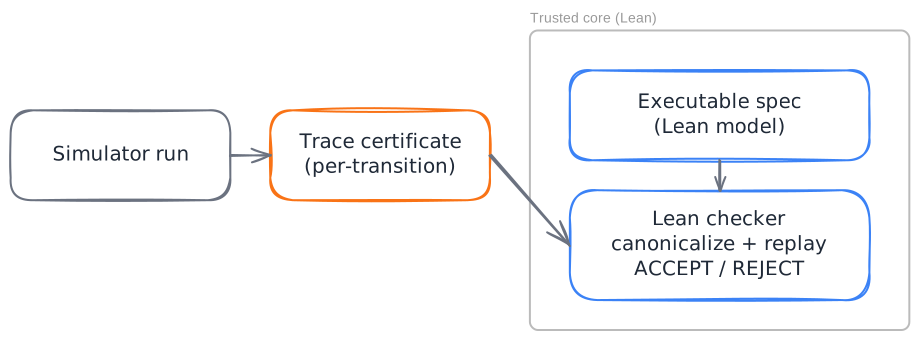
Core idea: trace certificates + trusted replay
LeanGuard follows an "untrusted producer / trusted checker" workflow:
- Days emits a per-transition trace (one row per protocol transition), including a deterministic snapshot of post-state.
- A Lean 4 checker canonicalizes the trace (typically sorting by
(time_ns, event_id)and rejecting duplicates). - The checker replays an executable reference model and returns
ACCEPTorREJECTwith the first counterexample row.
See:
- /docs/verification/design (practical guide)
- /docs/research/design (more formal design notes)
- /docs/reference/traces/schema (row conventions and encodings)
Why canonicalization matters
Because Days can run many models concurrently, the physical file order of trace rows is not treated as semantically meaningful. Canonicalization is part of the specification: the checker defines what ordering is acceptable, and the simulator only needs to log enough information to support that ordering.
Scaling beyond one run: coverage-guided generation
The paper also describes a test generation loop that uses checkers as both:
- a correctness oracle (
ACCEPT/REJECT+ first failing step) - a semantic coverage sensor (which spec-level branches/obligations were exercised)
The generator mutates scenarios, keeps those that expand coverage, and minimizes failures into stable regression tests.
See:
- /docs/research/test-generation (paper-derived overview + results)
- /docs/reference/cli/leanguard-testgen (CLI reference)
Evaluation (high level)
The paper includes an experimental evaluation of:
- trace checking cost (runtime/memory) on a suite of protocol traces
- coverage-guided test generation behavior on a prototype corpus